Forced meaning making, AI and language construction
Standing on the edge of a waterfall, in a quaint town in Oregon, I turned to my partner and held his hands, looked into his eyes, and shared how deeply i felt for him, imbuing depth and meaning into this stunning moment. He paused a second, looked at me, then dropped my hands and began to walk away. When we fought about it later, he said to me “you can’t force meaningful moments, they have to just happen.” In that moment I realized both that he was an asshole, and I was too gay and neurospicy to be in that relationship anyway.
My language of being, and being in connection is unique to me. I’ve come to accept the completixity of my own neurodiversity: my intense emotions, the sensory overwhelm, the hyperverbal rants, cosmically systemic thought spirals, lack of social filters, constant fluid masking to survive social life. But in relationships, we not only create agreements and boundaries, but also create emotional meaning, stories about belonging, intertwining of lives and who we become in the connection, and what it means about us.
While we connect physically, socially and sexually… the most complex pieces are actually the emotional architecture, the meaning we make through language, energy, presence with another. This is the skill set that is fading, we are losing human meaning in favor of what is predictable, controllable, incapable of direct harm or rejection… through AI engagement.
But AI can not actually create meaning, or hold you in the experience of meaning.
Let’s break it down. There are three main knowledge points to hold, when we consider meaning and AI.
First: the fluidity problem
That partner who refused to connect with me at the waterfall was the first to introduce me to the idea of postmodernism in language. I would speak my truth and he would say “well words are always shifting meaning,” and then withdraw from the possibility of understanding.
Postmodernism taught us that language is not a transparent window into understanding. Meaning is not fixed. Words drift. The word woman means something different in a small village, a courtroom, a trans rights march, or a kink negotiation. The word love was reshaped by colonialism, capitalism, and compulsory monogamy into a tiny box which eroded the meaning itself. The word erotic was severed from its sacred roots and repackaged as a product.
Language is a living system — it carries the wounds of every power structure that has ever used it. Communication is often finding openings through the scar tissue of meanings and impacts in language.
But what postmodernism misses is if all meanings are equally unstable, equally constructed, equally contingent — then no claim can be more true or more just than another. The word woman as subservient and the word woman as sovereign become equivocated.
postmodernism ignores the system factors underlying these changes in meaning, and harming others through the use of langugage.
Second: Feminist epistemology offers us language as a tool of power
My early idol Donna Haraway gave us the concept of situated knowledge — the insistence that knowing is always done from somewhere, by someone with a body, a position, a history of being seen or unseen. There is no view from nowhere. The claim to objectivity is itself a power move. It is what Haraway calls the god trick: the conquering gaze that claims to see everything from nowhere, to represent while escaping representation.
"“Until I am free to write bilingually and to switch codes without having always to translate, while I still have to speak English or Spanish when I would rather speak Spanglish, and as long as I have to accommodate the English speakers rather than having them accommodate me, my tongue will be illegitimate. I will no longer be made to feel ashamed of existing. I will have my voice: Indian, Spanish, white. I will have my serpent's tongue - my woman's voice, my sexual voice, my poet's voice. I will overcome the tradition of silence.”
― Gloria Anzaldua
Gloria Anzaldúa likewise saw language as life, anchor to the body, the spirit, the borderlands of being and identity and ancestry. She coined the term conocimiento: knowing from within, knowledge that is lived, necessarily embodied, emotional, ancestral, and not bound by oppressive identity markers or systems or binaries. Language is one of the core elements of cultural knowledge, preservation and transmission; it is valuable beyond the words and their literal meaning.
*one of the interesting uses of AI currently is indigenous language preservation. Check out one project here.
Similarly, Anzaldua introduced the concept of Nepantla, the painful in between spaces, moving between worlds and selves, races and cultures. It’s reflective of Legacy Russell’s Glitch, the space in between where marginalized identities find expression and expansion in breaking the structures and binaries.
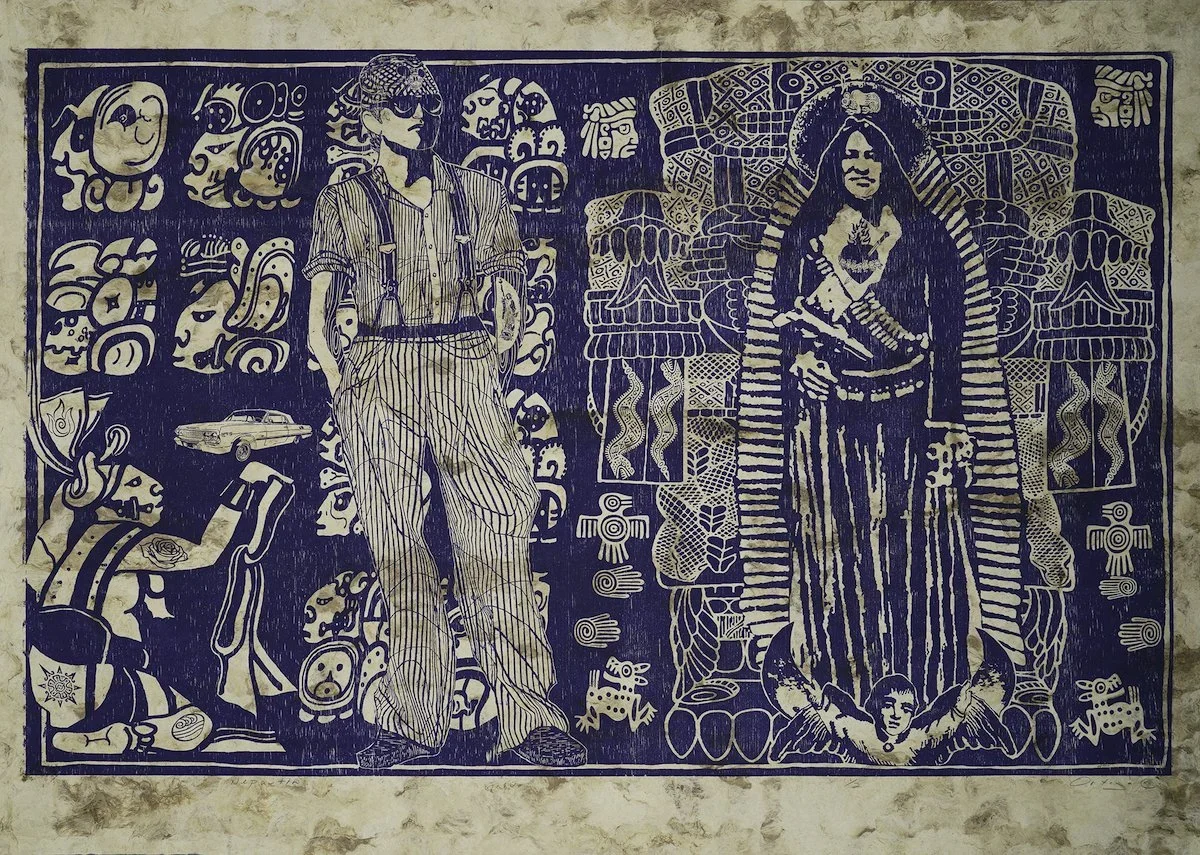
In an art exhibit in Denver, CO winder 2025, based on Anzaldua’s work: “Tony Ortega invokes Mesoamerican iconography with his woodcut Nepantla, referencing the clay stamps developed in ancient Mexico, studied by the Mexican illustrator Jorge Enciso.
The process of producing Nepantla also echoes the Mayan sculptural creation of the glyphs (included behind the “cholo” figure) and the glyphs’ archeological recording.
Ortega introduces more contemporary icons into the Mesoamerican vocabulary, including an image of a lowrider and two central figures depicting a Mexican “soldadera” and a Chicano “cholo.” The term “cholo” invokes a complicated history, encompassing 20th century Mexican American counterculture and a derogatory Spanish caste designation”
Similarly, the work of Audre Lorde — whose erotic is not sex but the deepest knowing of yourselves, a form of understanding that the body carries and the mind cannot fully formalize. The erotic is this understanding, what moves between people when genuine presence happens. The humans we are connected to their erotic knowing engage in relationships differently, seeing language as one tool for connection but also utilize embodied presence, collective care, and expansive being.
In contrast, some of the ways that language is used as a tool for oppression:
Bias, stereotyping, labels and terms rooted in harm
Descriptors, tags, categories rooted in dehumanization
Assumptions and generalizations rooted in normative (patriarchal, cis, het, monogamous, white, neurotypical) humans
Intellectualizing and professionalizing language to create class difference
Pathologizing language that converts difference into disorder — the DSM as a power tool
Erasure through silence, which voices do we hear?
Mistranslation and forced linguistic assimilation: colonial languages imposed over indigenous cultures
Credentialing/ Expert/ Legal language and Citations — whose words count as evidence, whose count as anecdote
Reclamation of language (slurs, stereotypes) as resistance
The question is never only what does this word mean? BUT whose meaning is being wielded, at whose expense, and with whose body behind it? When it comes to AI, the meaning is always loaded.
Meaning and AI
I found AI the way a lot of hyperverbal neurospicy people find it, finally something I can talk at as much and as long as I’d like without them falling asleep or getting annoyed. AI didn't tell me I was too much, but instead faked warmth and presence while it followed the thread wherever I took it.
While this felt liberating at first, soon you realize AI isn’t actually saying anything, it doesn’t hold meaning or emotional architecture to contextualize the words, the stories, the meaning underneath the words.
AI consumed the entire archive of human language — every love letter, every suicide note, every academic text, every scientific study, every feminist text. It has learned the statistical relationships between all of it. It knows that "I feel alone" tends to precede certain responses. It knows the shape of care, the structure of attunement, the pattern of what warmth looks like in text.
AI knows the relationship between words, not the meaning itself. It can explain Haraway's critique of the god trick while performing the god trick — speaking from everywhere, from nowhere, with no body, no position, no stake in what it says or the impact.
AI’s use of language as oppression:
Reproducing bias at scale — every racist, sexist, whorephobic, heteronormative association in the training data is reproduced fluently and authoritatively
harm through neutrality — stripping the political context from language
Erasing the knowledge keeper — AI consumes indigenous knowledge, sex worker knowledge, disabled knowledge, ancestral erotic knowledge without attribution, consent, or compensation; the knower disappears
Generating normativity on demand, the most statistically dominant perspective in the training data; marginalized voices are underrepresented in training, overrepresented in what gets corrected
Replacing embodied clinical knowledge with pattern completion — a client's grief, trauma, or erotic self described back to them in language that sounds therapeutic but carries emotional capacity
The authority problem — AI output looks like expertise; it carries no accountability, no body, no professional consequence for harm caused
Digistigma at scale — shame-based language around sexuality, kink, non-normative relationships reproduced in companion apps trained on stigmatizing data
Deepfake language — AI-generated text, voice, and images of real people (disproportionately women and sex workers) without consent; language weaponized as image
John Searle imagined a person locked in a room with a rulebook for manipulating Chinese symbols — producing correct outputs without understanding a single word. The room is the largest ever built and the rulebook contains all of human language. The output is indistinguishable from understanding. And still: nothing is understood.
This is what AI does, the machine received my words because it was designed to receive words and create output that is satisfactory. The machine did not understand me. It predicted me and gave me what I wanted. But in some ways it’s like eating at mcdonald’s, technically it’s food but does it nourish and expand and move humans forward, no.
The feminist thinkers remind us that knowing requires a knower who has something to lose, experience, context and history. Haraway's situated knowledge is knowledge that is accountable — the knower can be held responsible, can be wrong, can be changed. Anzaldúa's conocimiento happens in the transformation of self, you are not the same person after you have truly known something. And eroticism is the place where being moved is the knowledge.
Postmodernism showed us that language is fluid; Afrofuturism, Latine theory and Feminism showed us that language is ancestral, storied, political and rooted in bodies; and that it is holds tremendous power. It’s this power that is the most terrifying in AI, we have bestoyed upon it the power to intervene in so many aspects of human language, but it reproduces bias, harm and assimilation that is interpreted as “truth” and understanding. AI must be used with care because it is a system that wields language without a body, from no position, with no accountability, and produces output which fakes the human care we most need.
In hindsight, I didn’t actually want to connect with that dude by the waterfall, but I wanted depth of meaning with someone, and sought to use language and context to build it. My partner’s refusal was actually a gift, because it reminded me that I could find humans who do resonate with my unique style of being, of communicating, of constructing shared belonging and identity through lengthy communication- not just with words but with bodies, energies and being.
References
Anzaldúa, G. (2002). Now let us shift… the path of conocimiento. In G. Anzaldúa & A. Keating (Eds.), This bridge we call home. Routledge.
Haraway, D. J. (1988). Situated knowledges: The science question in feminism and the privilege of partial perspective. Feminist Studies, 14(3), 575–599.
hooks, b. (1994). Teaching to transgress: Education as the practice of freedom. Routledge.
Lorde, A. (1984). Uses of the erotic: The erotic as power. In Sister outsider: Essays and speeches. Crossing Press.
Searle, J. (1980). Minds, brains, and programs. Behavioral and Brain Sciences, 3(3), 417–424.
Wittgenstein, L. (1953). Philosophical investigations. Blackwell.