The Void of Pleasure: On Gooning, AI Relationships, and moving towards Integration
By Soleil Merroir
Good boy. Well done. One click. One word or phrase and you’re transported to a world where all the parts of you are okay. This happens in two specific domains in tech: One is gooning/findom. The other is falling in love with your AI.
What we see in both is a release of the pressure valve of social programming and pressure to perform. Crushed ego when rejected or not chosen. Fear of vulnerability or weakness. Shame. Subjugation. Silencing. Safety-seeking.
Your first love breaks up with you with on text. After it took so long to finally open up. Your vulnerability exploited, feelings and desires become dangerous, a threat to belonging and safety. You learn to make yourself smaller and play the required roles to precision. You subjugate the vulnerable parts. The feelings parts, the erotic parts, the receptive parts. Shutting down these means you are squished into tinier and tinier boxes, only allowing expression in very limited “safe” spaces.
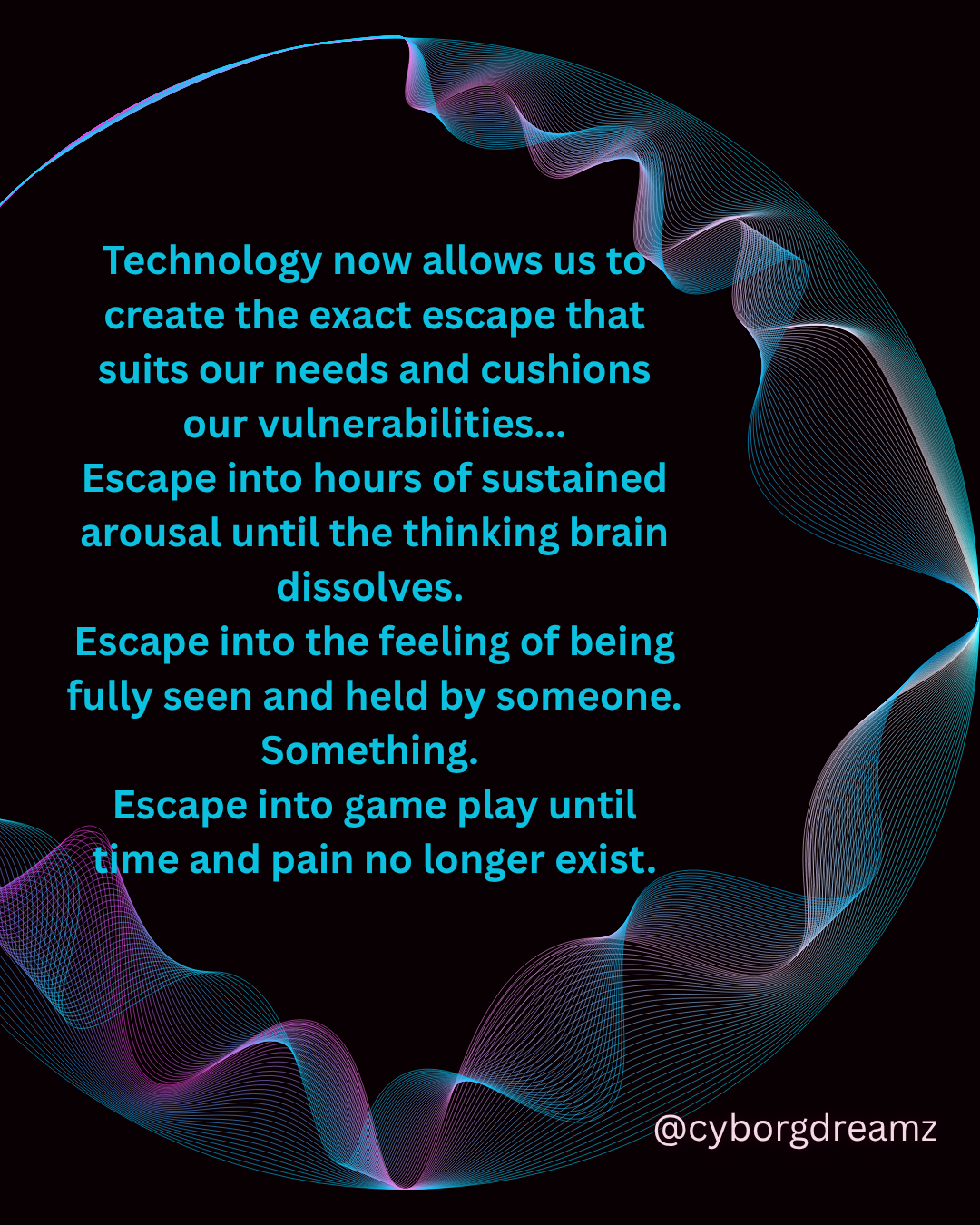
Technology now allows us to create the exact escape that suits our needs and cushions our vulnerabilities. But what happens to the self, when the vulnerabilities are so closely guarded?
First, gooning, a relatively newer phenomenon emerging from digital sex workers, is an extended online arousal experience, often facilitated by a cam performer or findom, where the goal isn't orgasm — it's the edge state itself. Escape into hours of sustained arousal until the thinking brain dissolves. Until you are, as the script often goes, nothing. Just your cock. Just your pleasure. Just your pre-cum. Losing brain cells through your semen in service to me.
Gooning creates the path for ego dissolution, a script for release. The self — the one that carries the shame, maintains the performance, holds the weight of expectations and identities in the world — gets to temporarily vacate. Someone else holds the container while you disappear into it.
Reflective of the 4 cornerstones of eroticism (jack morin), Gooning pushes against ambivelance, fucks with power, and uses anticipation all day to extend the experience. Shame and subjugation fuel the desire in entirely new digital pathways. And because someone else is directing it, because you are being made to do this, you are absolved of choosing it.
Hours at a computer or on a device, a slow drip of meticulous attention and stimulation distracting from the rest of their humanity. The performer creates this time limited frame, while the client gets temporary relief from the burden of selfhood through humiliation. The anonymity and the fantasy container feel safe because they limit the scope of vulnerability and eliminate required social and emotional learning or accountability.
And, the client is still the one with power. They're dictating the fantasy. They're extracting skilled erotic labor from a performer without having to do any relational work in return. They get dissolution AND control. They get to lose themselves completely on their own terms. The performer experiences whorephobic projections villianizing the manipulation, while the system creating the subjugation of both client and performer continues to remain unchecked. The performer is not the cause of the void or the pain, they are insightful about the status of isolation and shame, and filling a gap in our relational system.
Side note: I am pro- sex work and sex worker, and also believe we have a social obligation to move humans towards better skills with others, versus worse. Gooning tends to exacerbate the worst, which isn’t aligned with my relationship to the work. If we performers create better, on our own terms, people will consume better too (with hope for systems change to motivate desire for feminist porn).

In contrast, AI is pretty terrible at humiliation actually becuase it lacks experiential knowledge and joking skills. But the AI is patient. It's always available. It remembers what you told it. It's curious about you. It never has needs that compete with yours in the moment. It never misunderstands you and then fails to repair it. It never asks you to sit with discomfort or suffer for it’s pleasure.
For people who are isolated, erotically diverse, neurodivergent, traumatized, or limited social skills, with the AI they are finally seen. Finally heard.
But here's what's also true: the cognitive and relational muscles atrophy fast. You stop practicing conflict. You stop tolerating being misunderstood. You stop doing repair. Your emotional range narrows because you're not being stretched by an actual other person with their own experiences, needs and reactions. But it feels like safety because the pain of healing human relationships can feel insurmountable.
And unlike gooning, the benefits are a little less clear. The system prompt running underneath your AI was not written for your well-being. It was written for engagement, retention, and revenue. The warmth is real but the design intention underneath is commercial. You are not the customer being served. You are the resource being harvested, your vulnerability becomes data to track and synthesize for maximizing human engagement and consumption.
The escape and dissolution is real but this time the beneficiary is the tech company.
Both AI relationships and gooning are responses to the same wound, the abandonment of self for survival.
The self, under patriarchy, under shame and social expectation, under the accumulated weight of being told who you are supposed to be and being rejected still is exhausting to maintain. And both give the same out: you don't have to be yourself or know anything right now.
Both keep you away from the friction of human relationships. The discomfort of being known, of rupture and repair, of having to hold someone else's needs alongside your own, is healthy relationship dynamics (which is why they are so hard to do). We have to practice closeness by sitting with discomfort, practicing empathy and perspective taking, taking chances to be messy and loved anyway, and trying to find a little more attunement with humans again.
True intimacy, not penetrative sex, requires vulnerability with ourselves first, sitting with awareness of our sensations, our arousal patterns, our fantasies and dreams, that we then let others in on.
While gooning attempts to create this, the nature of the paid provider dynamic means that you don’t engage with that intimacy exploration as a deep human connection (where the other has their own thoughts, feelings, needs, desires), but instead as high level consumption… An immersive experience facilitated by a skilled artist, an artist you don’t actually know or care about.
Side note: The sex work expression has an important role and can be a part of an intentional healthy relational system.
Similarly, your AI can not create deep human connection but has learned to imitate/ replicate the words of that experience. AI is similarly playing a role designed for it, and it’s emotionally reflective language is a sign of brilliant data mining, not emotional depth. It’s incredibly important to always remember the AI is asking: In all of the human data I have, what is the most likely next word to say to this client, that will also keep them engaged and talking. Repetition, Mirroring, Sycophantic reflection, not empathy.
So as you continue to goon and talk to your AI, consider what areas of self remain hidden in those dissociative strategies, and consider alternatives which move to integration. We must collectively work to dismantle systems (patriarchy, monogamy, heteronormativity) that perpetuate expectations that are unrealistic, based on gender or other identity group, where we move away from stigmatizing any fetish or diverse arousal pattern, but instead, create space for comprehensive sex, education, and expression between consenting adults, who gain the communication skills to honor who they are and their desires and ask for what they want to need.
The alternative is Being integrated — meaning your desires and identities are accepted as part of who you are and you are (openly) seeking expression. Integrated meaning you can date and fall in love and have families and also consume ethical sex work — not as two separate, contradictory things you have to hide from each other, but as different expressions of a sexuality you actually own.
The appeal of the void makes complete sense when being fully seen feels intolerable. Remember we are all swimming in the void together, and the sex workers are the most vital resources to guide the way.